
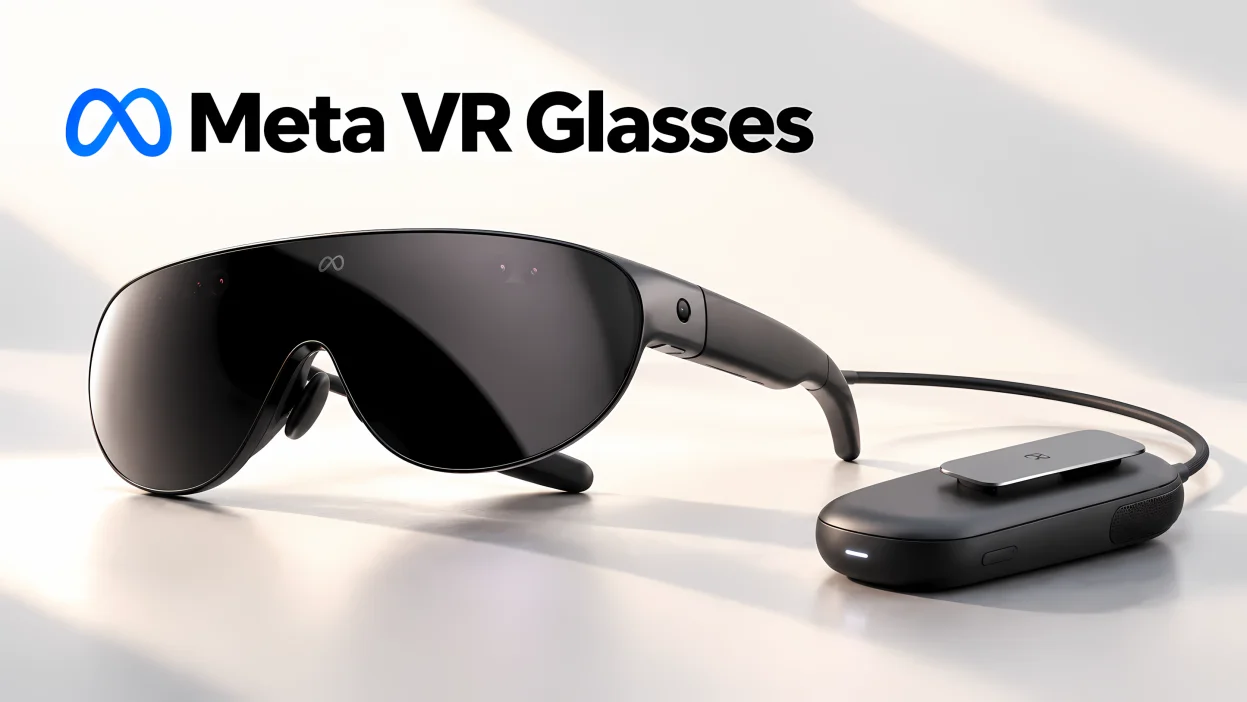
VR has spent years getting sharper, faster and more capable, but one physical problem has remained: most of the hardware still sits on your face. Meta VR Glasses take a different approach. The glasses themselves weigh about 100g, roughly one fifth the weight of Meta Quest 3 according to Meta, and they avoid the large straps and heavy front section we normally associate with VR headsets. Instead, the system is split in two. The glasses handle the displays and sensors, while a separate compute puck connected by an optical tether carries the processor, battery and storage and can clip to a pocket, belt or bag. That is the key ergonomic idea behind the product. Meta is not making all of VR hardware disappear. It is moving the heaviest parts somewhere your body can carry them more comfortably.
That design could make a bigger difference than another jump in processing power. Headsets such as Quest 3 keep nearly everything in one self-contained device, while Apple's current Vision Pro weighs 750 to 800g on the head, plus a separate 353g battery. Meta's approach puts far less mass on the forehead, cheeks and nose, which could make long sessions easier for movies, flights or work. But there is still a tradeoff. You now have a puck in your pocket and a cable running to the glasses, so the system is lighter on the face but not completely wireless or self-contained. Meta says the puck provides up to three hours of continuous high-resolution media playback and supports 45W charging. In other words, the comfort problem is reduced by moving weight away from your face, but you still have to carry that hardware somewhere.
Meta also did not reach 100g by turning these into basic display glasses. The official developer specifications list micro-OLED displays at 2412 × 2288 pixels per eye, 37 pixels per degree and up to 120Hz, with Dolby Vision, HDR10 and HLG support. The glasses include eye, hand and head tracking, full-color stereoscopic passthrough with autofocus and depth sensing, 12GB of memory and Dolby Atmos audio integrated into the frames. The main compromise appears to be field of view rather than sharpness. Meta VR Glasses offer a nominal 70-degree horizontal and 66-degree vertical field of view, while Quest 3 reaches 110 by 96 degrees. That means the Meta glasses fill less of your peripheral vision, but in exchange they are dramatically lighter and keep the sides more open so you remain more aware of the room around you.
The lighter form factor starts to make more sense when you look at what Meta expects people to do with them. The company is pitching the glasses as a personal cinema, workspace and gaming device. You can create one large virtual screen or several, and Meta says a flat table or desk can become a virtual keyboard and touchpad using its surface input system. Eyes and hand gestures are the main controls, so a controller is not required for normal navigation, while more than 75 games are expected to support hand-only play at launch. The glasses are also the first IMAX Enhanced certified VR device according to Meta, with 3D movies and more than 100 immersive live sports events planned each year. Those are exactly the kinds of experiences where weight matters. Watching a full movie or working across several virtual screens for hours is much easier to imagine when the device on your face weighs about as much as a deck of cards instead of several hundred grams.
The split-compute idea also puts Meta in the same broader direction as XREAL Aura, which keeps high-performance compute in a separate puck while leaving a lighter spatial display on the face. XREAL uses a 70-degree optical see-through display and Android XR, while Meta uses micro-OLED displays and camera passthrough for VR and mixed reality. The systems are different, but the design lesson is similar: not everything that powers spatial computing needs to be strapped to your head. That may be one of the most important changes in the next generation of XR hardware. Meta VR Glasses still have compromises, including a narrower field of view, a tethered puck and roughly three hours of high-resolution media playback, but the 100g design changes the problem from "how powerful can we make a headset?" to "how little hardware actually needs to stay on your face?" Meta plans to launch the glasses in spring 2027 for $1,299.99, so the real test will be whether carrying that puck feels like a fair price for making VR much easier to wear.
Meta VR Glasses Bring Immersive VR Down to Just 100g
YOU MAY ALSO LIKE THESE ARTICLES
Vivo V80 Lite Packs a Monster 10,000mAh Battery Into a Slim Body
Vivo fits 10,000mAh into a slim phone, showing how new battery tech could change daily charging habits and reshape future smartphones.
Ray-Ban Meta Gen 3 Review Meta Made AI Glasses Easier to Live With
Ray-Ban Meta Gen 3 gets a slimmer design, more frame styles, prescription options, better microphones, longer battery life and Muse support on the way.
Xiaomi UltraThin Magnetic Power Bank Packs 5000mAh Into Just 6mm
Xiaomi packs 5000mAh into a magnetic power bank just 6mm thin. We look at how it feels in daily use, how much charge it can deliver, and whether the slim design is worth carrying.
How Apple Silicon Is Building the Future of Local AI
How far Apple can push AI onto iPhone, iPad and Mac as unified memory, Neural Engine and models like AFM, Llama, Qwen and Gemma bring more intelligence on-device