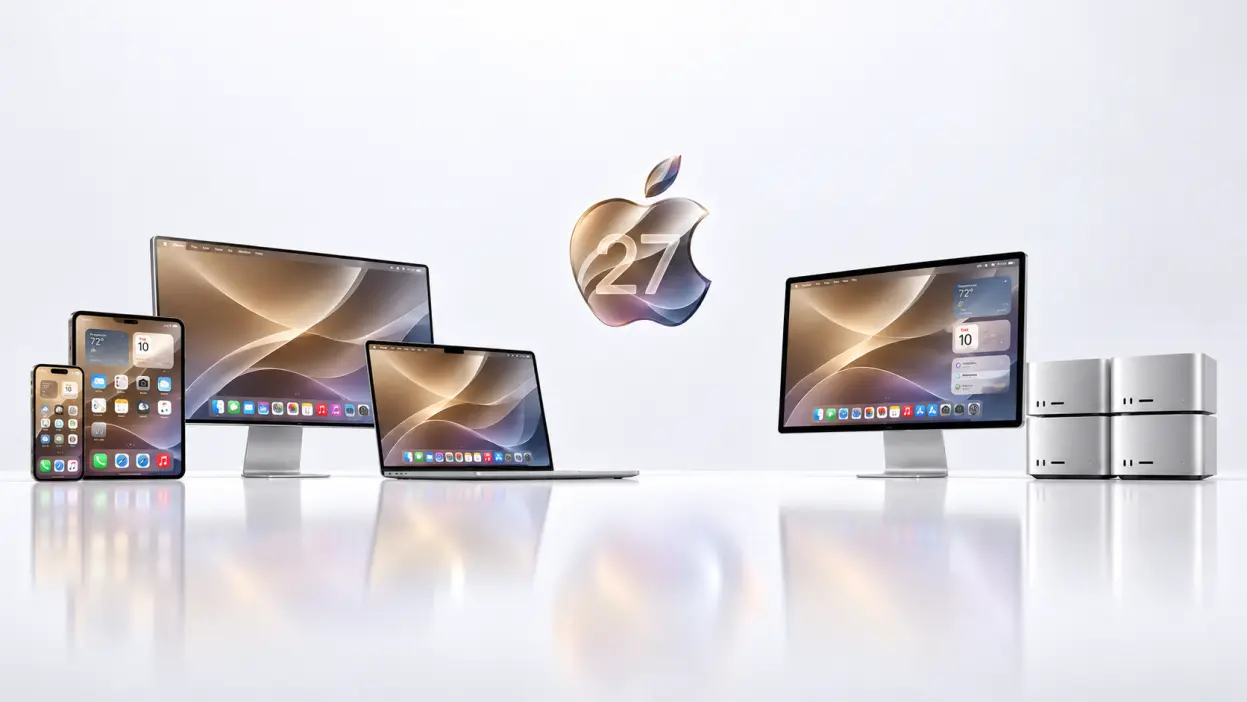
AI is starting to move closer to the devices we use every day. While the biggest models still depend on massive data centers, more everyday AI tasks can now happen directly on phones and computers instead of sending everything to the cloud. Apple has been moving in this direction with Apple Intelligence, where supported devices can process certain requests locally and hand more demanding tasks to Private Cloud Compute when additional processing power is needed. With iOS 27 and Apple's latest Foundation Models framework, that local side is becoming considerably more capable.
There are several reasons why this matters. Local AI can respond without waiting for every request to travel to a remote server, it can keep more personal information on the device, and it reduces how dependent an AI experience has to be on constant cloud inference. For developers, smaller tasks running locally can also mean fewer workloads that need external compute. Apple is not abandoning the cloud, but its approach increasingly treats it as something to call when the device itself is no longer enough.
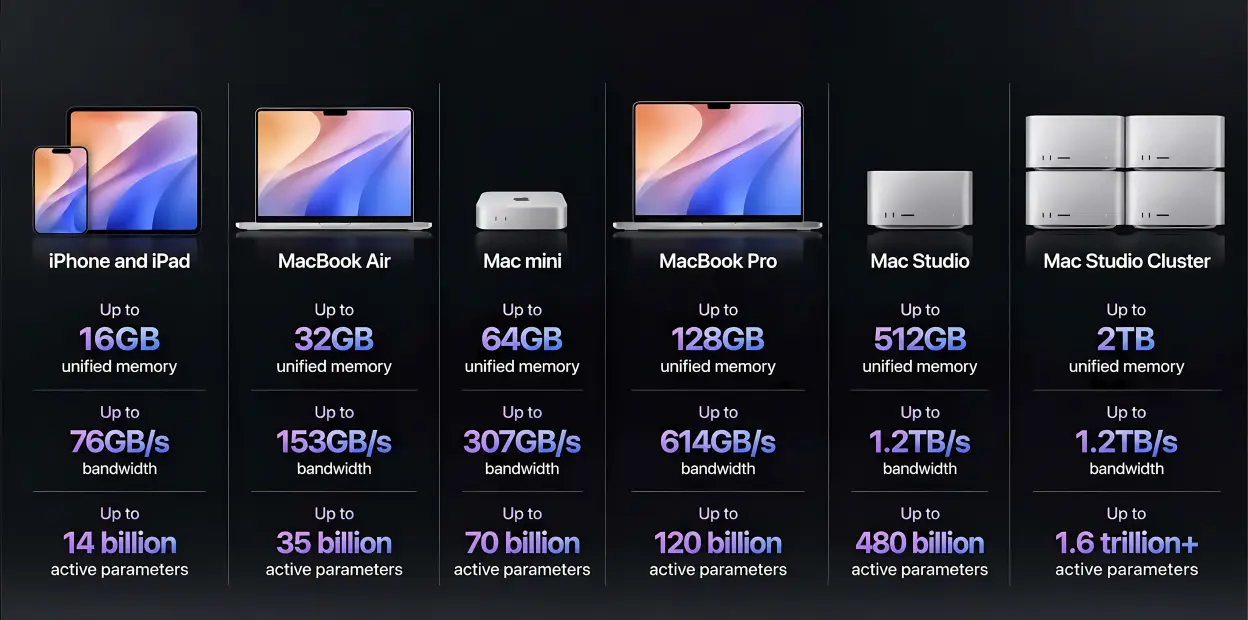
A major part of Apple’s advantage here is its hardware architecture. Apple silicon uses unified memory, which allows the CPU and GPU to access the same memory pool without constantly moving data between separate memory spaces. Apple’s MLX framework is designed around this architecture, which matters for AI because model weights, context, and intermediate data can consume large amounts of memory. As the image above illustrates conceptually, devices with more unified memory and bandwidth can support increasingly demanding local AI workloads, although the exact model size still depends on factors such as quantization, architecture, context length, and available memory
That capability is not limited to Apple’s own models. Apple’s current on-device family includes the roughly 3-billion-parameter AFM 3 Core and the 20-billion-parameter sparse AFM 3 Core Advanced, which activates only part of the model depending on the task. Macs can also run third-party models locally through tools built around MLX, with families such as Llama, Qwen, and Gemma available in different sizes and quantized versions. The comparison above helps show why the experience can vary so much across Apple hardware. An iPhone is better suited to tightly optimized features such as Siri, writing assistance, and personal intelligence, while higher-memory Macs can handle larger assistants, coding models, multimodal systems, and more demanding local agents.
Apple is therefore building toward a future where the cloud becomes only one part of the AI stack instead of the place where everything has to happen. Its combination of Apple silicon, unified memory, dedicated machine-learning hardware, and increasingly capable local models allows more intelligence to move directly onto the devices people already own. Apple is not alone in this direction, but the broader trend is becoming clear. As hardware improves and models become smaller and more efficient, AI is becoming more accessible offline and less dependent on a remote server for every interaction.